Buy any 1 product and get 1 absolutely free — this offer applies to all Website Templates, UI Kits, and Complete Scripts.
Buy Now! Article Information Table Of Contents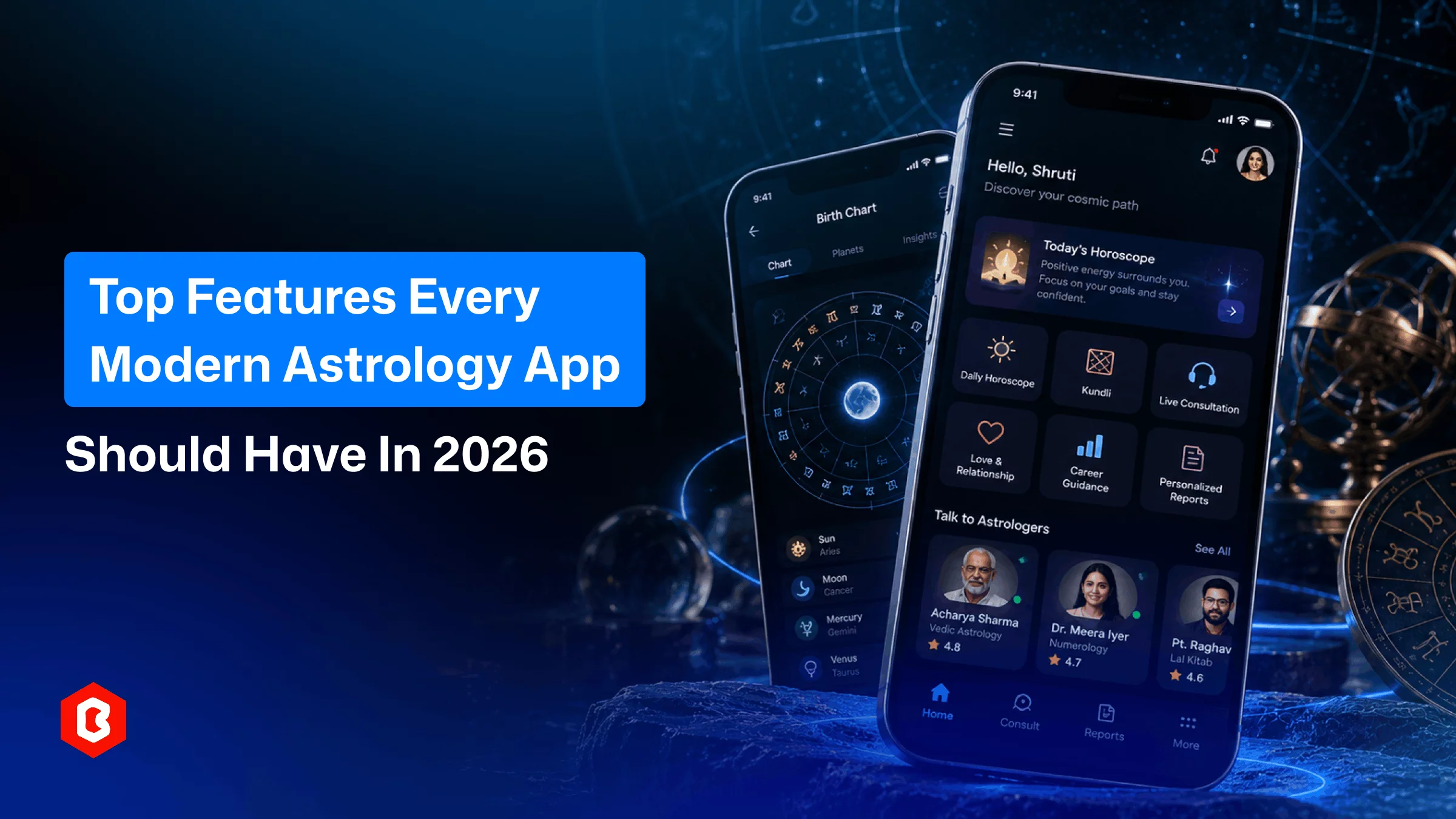
An astrology app has to do more than show a daily horoscope. Nearly 80 million people now use religion, spirituality, and astrology apps each month in India. That figure has more than doubled since 2023, according to Sensor Tower's 2026 India report.
The money is moving online too. Astrotalk reported ₹1,176 crore in operating revenue for FY25. That was up from ₹651 crore the year before. InstaAstro crossed 12 million registered users after growing its base by roughly 400% in two years.
Users now have plenty of choice. A basic horoscope is not much of a reason to stay. Better astrology apps make charts easier to read. They also make consultations easier to book and personal readings easier to find.
That is where the best astrology app UI UX design ideas become important. The winning interface is not the most decorated one. It is the one that gets users to useful information faster.
A home screen should not waste the first five seconds. Show the user's horoscope. Show the next important transit. Keep the birth chart close. If the user has an active consultation, show that too.
The order matters. A first-time visitor may need an explanation of the app. A returning user does not. They already know what they came for.
The simplest setup is usually enough:
Home element | What it should do |
Daily reading | Give users an immediate reason to open the app |
Birth chart | Provide one-tap access to personal astrology |
Planetary events | Show what is happening next |
Saved profiles | Let users switch between charts |
Consultation | Make live help easy to reach |
You do not need ten cards above the fold. More choices do not automatically create more value. They often create more scrolling.
Birth charts contain a lot of information. That is the problem.
A new user sees houses, planets, signs, degrees, and aspects at once. An experienced user may understand it immediately. Everyone else needs help.
The chart should answer the first question without opening another page. Tap Venus. Explain Venus. Tap the seventh house. Explain the seventh house. Keep the deeper interpretation one step away.
This is one of the biggest jobs for modern astrology UI. The interface has to simplify the chart without stripping away the useful detail.
A good rule is simple. Show the meaning first. Show the technical information after.
Most astrology apps collect birth information during signup. Some stop there. That leaves a lot of useful data sitting unused.
Save the birth date. Save the time. Save the location. Then use those details across the app.
The same profile can support daily readings and birth charts. It can also provide planetary transit information and compatibility reports. Users should not have to enter their information again.
This also changes the app’s experience. A generic horoscope is easy to replace. A personal astrology profile isn’t.
Daily readings are common. That doesn’t mean they should always look the same.
A long block of text is not readable. You should break it into useful areas. Love. Career. Money. Relationships. Mood.
A user can then read what matters and move on.
Weekly and monthly readings can have more details. They have more room for context. The daily version should stay quick.
This is where a good astrology app UI can make ordinary content feel more useful. The content may be similar. The way people reach it is not.
A user may want to know more than today's horoscope. They may want to know what happens next.
Retrogrades. Sign changes. Major transits. Lunar events.
A calendar can handle this well. So can a timeline. The important event appears first. The explanation comes after.
Example: a user could see an upcoming Venus transit with the date. Tapping the event opens the interpretation. This process is effortless. But searching through a long article isn’t.
And the interface does not need to animate everything. A moving planet may look good in a demo. It can be annoying when the user is reading.
Relationship questions are already a major part of online astrology. Digital platforms have turned them into a repeat-use feature.
The flow should be simple. Add another person. Enter the birth details. Generate the report. The real work starts here.
Do not show only a compatibility score. A number like 82% looks precise. You should show the areas behind the score. Communication. Emotional connection. Attraction. Long-term patterns.
The user gets something to read. They also get something they can understand.
AI is already moving into astrology products. AstroSage said its AI astrologer business had passed 80 million downloads and 1.5 million daily active users. The company also reported 20% month-on-month AI growth over 18 consecutive months.
Those numbers make one thing clear. AI is not just a design experiment anymore.
But a chatbot alone is not enough.
The useful version knows what the user is looking at. If the user opens Mars in a birth chart, the AI should be able to explain Mars. If the user opens a transit, the AI should be able to explain that transit.
The user should not have to copy information from one screen into another.
That is the difference between adding AI and actually using AI.
A premium plan should be worthy enough to purchase.
More detailed birth chart readings can work. Advanced compatibility reports can work too. Unlimited AI questions. Priority consultations. Deeper transit reports.
The list does not need to be long.
Show what changes after the upgrade. Put the price beside it. Let users compare the free and paid experience without hunting for the difference.
That is one of the more practical premium astrology app design trends for 2026. Premium should mean more useful. Not simply more screens.
Digital astrology is not limited to automated readings. Live consultations are already a large business.
Astrotalk reported more than 1 lakh minutes of daily consultations on its own platform. Its service also spans more than 60 countries and includes over 13,000 astrologers.
That creates a different design problem.
Users need to find the right astrologer quickly. Show the specialty. Show the rating. Show the price. Show whether the astrologer is available.
Do not hide the important information behind several screens.
A consultation can be expensive. Users should know what they are choosing before they pay.
Astrology is rarely limited to one chart.
People check partners. Friends. Children. Family members.
Let users save those profiles. Give each one a clear name. Make switching between them easy.
This becomes especially useful for compatibility tools. It also saves repeated data entry.
One small detail matters here. Always show whose chart is open.
A wrong profile can produce a very confusing reading.
The most visible features are not always the ones that bring people back.
Daily readings help. Saved charts help. Notifications help. So do transit alerts and consultation history.
The trick is not to notify users about everything.
A daily horoscope alert makes sense. A major planetary event may be worth another alert. Ten notifications in one day will probably do more harm than good.
Give users control over them.
That is basic UX. It is also easy to overlook.
This is where an astrology app can have more personality than a typical utility app.
Dark themes work well. Constellations can create depth. Planet illustrations can make your app unique. Small animations can make smoother transitions.
But there is a limit.
If the text is difficult to read, the design has gone too far. If the chart disappears behind decoration, the design has gone too far.
The visual layer should support the content.
That is the point of a good astrology app UI. It can feel mystical without becoming confusing.
Astrology products can grow very quickly.
Horoscopes. Charts. Compatibility. AI. Tarot. Numerology. Consultations. Transits. Profiles. Stores.
Put everything in the main navigation, and the interface becomes a menu.
Keep the core areas visible. Put the rest inside them.
A simple structure could be:
Home | Horoscope | Chart | Explore | Profile
The exact labels are not important. The number of choices is.
The astrology app market is getting crowded. India alone is projected to grow from about $390 million in 2026 to $2.32 billion by 2032 in one recent market estimate. That is a 34.61% CAGR.
More apps will enter the space. More features will follow. AI will become easier to add. That does not mean every app will become easier to use.
The strongest products will focus on the basics first.
A useful home screen. A readable birth chart. Personal readings. Better compatibility reports. Clear planetary tracking. AI with context. Premium features that make sense.
The goal is not to build the longest feature list.
It is to remove the friction between the user and the answer they came for.
That is where the best astrology app UI UX design can make the biggest difference.
A modern astrology app should offer the following features:
Daily readings
Birth charts
Compatibility reports
Planetary tracking
Personal profiles
Notifications
AI tools
Live consultations
A good astrology UI makes complex information easier to understand. Charts should be readable. Navigation should stay simple. Important information should not be buried under decorative elements.
Personalization is a major trend. AI-based readings are also growing. Interactive birth charts, planetary tracking, live consultations, and clearer premium experiences are other useful directions.
It can be useful when it has context. AI can explain a chart placement, answer questions about a transit, or help users understand a compatibility report.
Personalized content gives users a reason to return. Daily readings, saved profiles, transit alerts, consultation history, and useful notifications can support repeat usage.
Birth charts turn a general astrology experience into a personal one. They can also support other features such as personalized readings, planetary transits, and compatibility reports.
 Tags
Tags  Similar Blogs
AI (Artificial Intelligence) is shaking things up in the education industry as well! According to a...
In today's world, web applications are controlling the business arena. Whether it's an eCommerce web...
Hamster Kombat is a tap-to-earn crypto game where players are designated as virtual CEO. In developi...
Online Sports betting apps are considered as the source of earning passive income but with that, the...
Every business needs better marketing to promote their products and services. Nowadays, they prefer...
The cryptocurrency world is transforming at every moment. That world is not just limited to only exc...
Related Products 
Not sure which template or UI kit fits your project? Reach out for expert advice.
 100% Satisfaction Guaranteed
  Shop with Confidence!