Buy any 1 product and get 1 absolutely free — this offer applies to all Website Templates, UI Kits, and Complete Scripts.
Buy Now! Article Information
Every therapy and counselling practitioner faces a question: Do you have a website I can look at? The online presence has become a basic expectation for mental-health services. People want to see who they'll be talking to, understand what services are offered, and feel some reassurance before they ever pick up the phone.
Therapists are not web designers; they need help from a web developer to help them making a website for appointment booking and service offering. The custom development process becomes expensive for them, and a badly planned DIY site can end up looking unfinished or, worse, untrustworthy. This is the real tension behind almost every therapist website Template project: the desire for a polished, credible site versus the limited time, budget, and technical patience available to build one.
That gap is exactly where ready-made website templates fit in. The layouts are available for customization, and HTML source code supports the basic functionality that can make a site live within a week.
It’s a pre-built set of pages and design elements that makes the front-end developer task easier. In website templates, multiple pages are available, designed, coded, and structured:
Homepage
About page
Service page
Contact form
For custom web development, every decision the team has to take is time-consuming, like which page structure to follow, how the spacing works, the navigation flow, color choices, etc. The template shortens these aspects into one package.
That said, a template is a starting framework, not a finished product. The therapist still needs to make the site genuinely theirs:
Branding including logo design, color choices, and tone of voice
A written description of services and specialties
A biography or "about" section that reflects real qualifications and approach
Accurate contact information and appointment details
Photography or imagery that feels authentic rather than generic
Calls to action that match how the practice actually wants new clients to get in touch
Skipping this customization step is the most common way a good template ends up looking generic site not professional. The template provides the frame, and the content is what makes it a real practice website.
It's simple: to save higher development costs and get a professional therapist website ready in weeks instead of waiting for months. After all, private practice, a small agency, or an internal project team with limited design resources utilize the templates.
But how can it help?
Utilizing the template gives a small team a quick route to launch the website. The basic layout work allows developers to start the customization and avoid design decisions.
For a solo practitioner juggling client sessions with website tasks, or a small agency managing several client projects at once, that predictability is more valuable than complete design freedom.
The website templates offer layouts for writing clear service descriptions, adding real photography, and presenting the mental health service therapy practice in a way. Instead of spending weeks on layout experiments, the effort shifts toward content and client experience, the parts of the site clients actually respond to.
You have the page structure and design work already done, so moving from decision to live website in a short time can be possible. Even a custom project website development will be managed. This matters for a new private practice that wants to start accepting clients sooner rather than later.
Prospective clients judge the therapy practice from a health practitioner within seconds of landing on the homepage. The premium template is designed for presenting the therapy or wellness service calmly. So, avoid the "corporate business" look.
Therapist website templates are built with a coherent design system that feels something unique and acceptable. This includes consistent spacing, typography, and color use across pages. That consistency is harder to achieve when pages are designed individually over time, especially by different people.
A large share of website visits now happen on phones, and a site that doesn't adapt cleanly to a smaller screen creates friction right when someone is trying to find a phone number or booking link. Mobile-friendly website optimization is not too hard as of now, but templates offer modern responsive techniques that are designed to adjust their layout across screen sizes as a baseline, not an afterthought.
When visitors move through a site, they look at how easy it is to navigate, like getting to the service page easily, as it increases the conversion chances. Then the page hierarchy is maintained well for experiencing the professional website, and content flow supports it.
In a website template, the basic structure already exists. The changes can be done for swapping content, images, and colors rather than rebuilding page logic. This is particularly true of templates built with modern, utility-based styling systems, which make visual tweaks more contained and predictable.
With a custom-built website, scope can quietly expand as new pages and features get added mid-project. A template sets a known starting point, which makes it easier to estimate what customization work is actually left.
A one-person practice or a two-person internal team doesn't need to make every layout decision from scratch. This frees up time for the clinical and business sides of running a practice.
Templates built around a mental-health or counseling context typically already include the kinds of pages a practice actually needs: services, appointment information, therapist or team profiles, and a way to get in touch. There’s no requirement for structure to be invented.
A well-structured template gives you sensible headings, page organization, and a place to publish ongoing content such as articles or resources. Buying a template does not automatically improve search rankings. Search visibility still depends on the website SEO practices, quality c of the written content, how the site is configured, and ongoing optimization over time. A website template simply gives that work a cleaner starting point.
When a business owner, a freelance designer, and a developer are all working from the same known template, conversations about what needs to change are more concrete and less work than "design me a website."
The template is only a design-ready tool, and to convert into a secure and professional website, the back-end integration and third-party platforms are required.
A ready-made template likely to be a sensible fit for:
Independent therapists launching a first website
Counsellors and psychologists who want a professional presence without a lengthy build process
New private practices that need to get online quickly
Existing practices redesigning a dated or hard-to-maintain site
Freelancers building sites on behalf of therapist clients
Small web agencies that want a reliable starting point across multiple projects
Internal teams with limited in-house design capacity
Require highly specialized functionality like a complex client portal or billing system integrations suitable for a custom website. For single-practice or small-group websites, the template-based solution is useful.
Multiple website templates are available in the market, but choosing the perfect one to suit a professional therapy practice. A few things are worth checking before settling on one:
Visual style that fits the field. Look for calm, uncluttered layouts rather than sharp ones.
Clear navigation. A visitor should be able to find services information and contact details easily.
Responsive design. Confirm the template adapts properly to phones and tablets and avoid screen glitches.
Readability. Font sizing, line spacing, and contrast should make longer service descriptions easy to read.
Accessibility considerations. Look for sensible heading structure and color contrast as a starting point.
Service presentation. Check that the layout has a natural place to describe different therapy approaches or specialities clearly.
About and profile sections. If the practice includes more than one clinician, confirm the template supports individual bios.
Contact and appointment pathways. Check the booking or contact information is easy to find.
Calls to action. Presenting a clear invitation to get in touch works better for mental-health audiences.
Customization options. Check how easily colors, fonts, and content sections can be changed.
Browser and device compatibility. The template has to work normally in Google Chrome, Microsoft Bing, and other search browsers.
The underlying code and technology: This affects how easily a developer can maintain or extend the site later for functionality.
Performance considerations: A slow-loading site can frustrate visitors before they see anything, and for that, website speed optimization solves problems before occurs.
Licensing terms: Know exactly what you're permitted to do with the template and prevent such legal issues.
Documentation and support: This matters if you or your developer run into setup questions multiple times.
Long-term maintainability: It means how easy it will be to update content or add pages a year from now as required.
Above all, the design should communicate trust and professionalism without feeling cold or overly clinical. For a therapist website, follow:
Avoid visual clutter and keep contact information easy to find
Describe services in plain language
Choose imagery that feels genuine rather than stock-photo generic
It sounds like a professional website for mental health services.
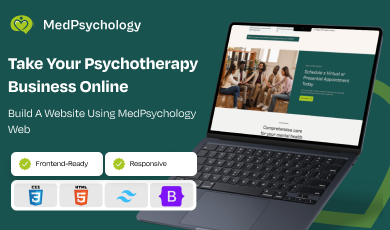
One option worth looking at is the Psychotherapy and Counselling HTML5 and Tailwind CSS Website Template, sold under the name MedPsychology. It's built specifically with a psychotherapy or counselling practice in mind.
In simple terms, HTML5 is the standard markup language browsers use to display a webpage's structure. Adding Tailwind CSS in website modern styling framework that developers use to apply consistent design choices: spacing, colours, typography, efficiently. Together, they give a developer a codebase that's straightforward to adjust without redesigning the site from the ground up.
The package includes different pages: home, about, appointment booking, and an appointment-type page. For lead generation, a standalone contact page, a blog page, and a testimonial section exist. That combination covers the core pages a psychotherapy or counselling website typically needs. It is a way to introduce the practice, explain services, showcase client feedback, and publish articles or resources. Visitors can get in touch or request an appointment.
This is useful for group practices or clinics with more than one therapist on staff. The template is documented and marked as frontend-ready and responsive-ready. It is suitable for psychotherapy clinics, medical service providers, and psychotherapy-focused facilities more broadly. It comes with the HTML, CSS, and JS files, the Tailwind CSS setup, documentation, and a read-me file. The license for use on your own or a client's project is offered.
What makes a purpose-built template like this useful is that the page structure has already been thought out.
Launching or redesigning a therapist website in 2026 doesn't have to mean choosing between a rushed DIY attempt and an expensive custom build. A ready-made template offers a middle path: a professionally structured starting point that already accounts for responsive design, sensible navigation, and the kinds of pages a therapy practice actually needs.
If you're evaluating options for a psychotherapy or counselling website, it's worth taking a look at the Psychotherapy and Counselling HTML5 and Tailwind CSS Website Template to see whether its page structure and design approach fit what your practice needs.
Yes, it has a professional structure without a lengthy custom build, which suits practices that want to launch efficiently. For specific technical requirements, like complex client portals need custom development.
They have to look for clear navigation, responsive, mobile-friendly design, readable typography, image sections, CTA buttons, and accessibility basics. Also, prefer a page structure that supports services, practitioner bios, and easy contact options in a calm and trustworthy manner.
Templates are usually faster and more cost-effective for standard practice websites. Fully custom builds make more sense when a practice needs unusual functionality or integrations that a standard page structure can't support.
Yes. Therapist website templates are meant to be adapted. The colors, images, text, and page content are typically changed to match the practice's branding and services. The amount of customization possible depends on the specific template and the technology it's built with.
Responsive design means the site adjusts automatically to different screen sizes. Visitors browse on phones, and a site that doesn't adapt well can make it harder to find contact details or book an appointment, which may cost you potential clients.
No. A well-structured template can provide a cleaner foundation for search engines to read. But actual search visibility depends on the quality of your written content, technical configuration, and ongoing optimization.
At minimum, most practices benefit from a homepage, a services or approach page, and an about or practitioner profile section. It also includes a clear way to contact or book an appointment and often a blog or resources section for sharing helpful content with visitors.
 Similar Blogs
Picking the perfect style for your website is a major decision, especially in the vast scope of web...
Designing and developing a website may look tough and time-consuming. It is actually tough when it c...
Developing a website has now been important to reach a wider audience. Performing web development fr...

In web development, choosing the right CSS framework can make a significant difference in the succes...
When the world is going online, having a responsive website that works flawlessly across all devices...
According to stats published on Forbes, 57% of internet users avoid recommending a poorly designed w...
Related Products 
Not sure which template or UI kit fits your project? Reach out for expert advice.
 100% Satisfaction Guaranteed
  Shop with Confidence!
 Tags
Tags