Buy any 1 product and get 1 absolutely free — this offer applies to all Website Templates, UI Kits, and Complete Scripts.
Buy Now! Article Information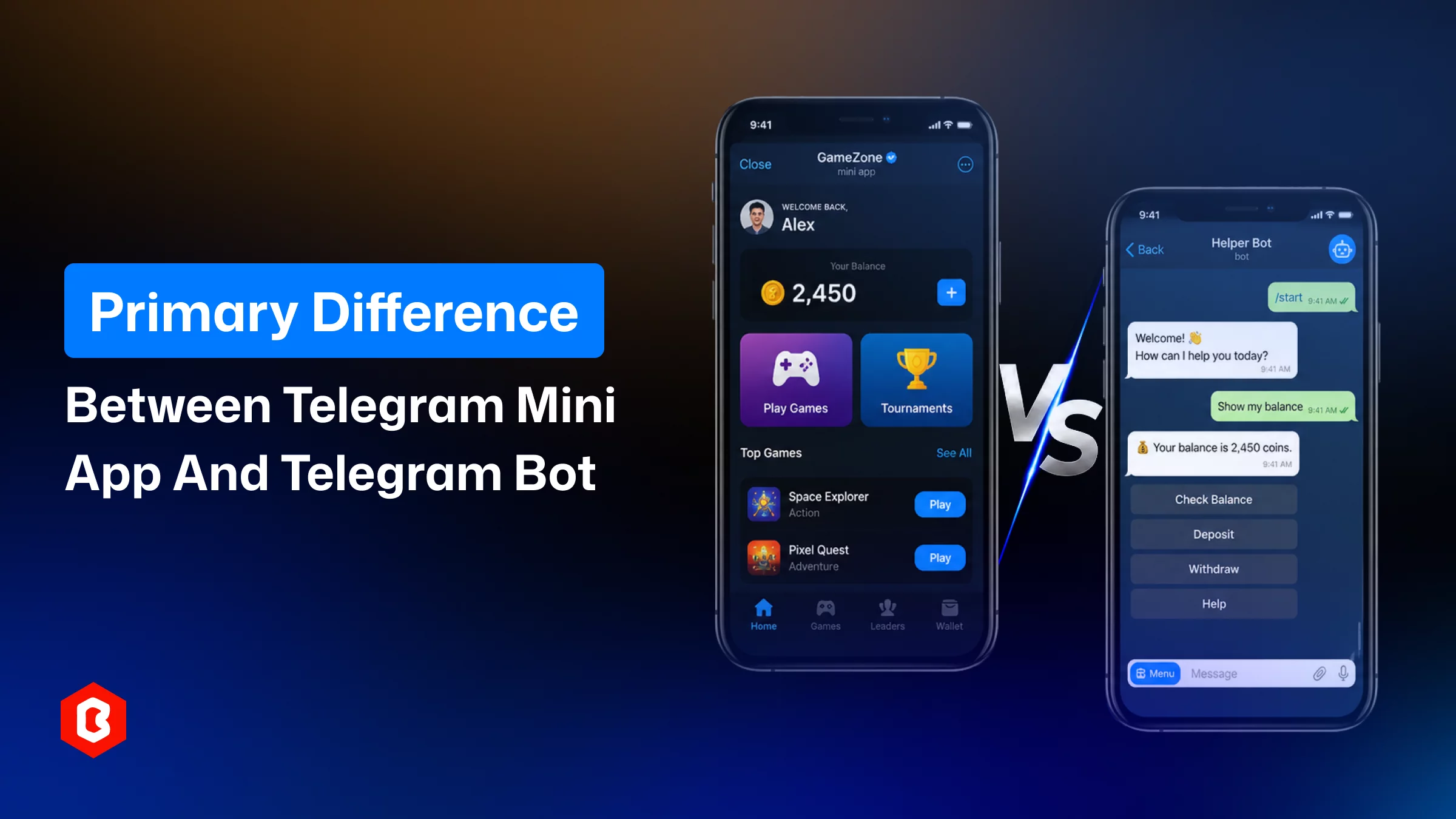
We know that Telegram is not just a messaging app with a reputation for privacy and speed. That's no longer the full picture. Somewhere between Notcoin's early tap-to-earn experiment and the runaway popularity of Hamster Kombat, Telegram quietly turned into something closer to an operating system. It becomes the platform where games, wallets, storefronts, and booking tools all sit a single tap away from a chat window.
If you run a business and you're wondering whether to invest in a Telegram bot development, a mini app development, or both, you're not alone. The two get used together constantly, and the confusion costs companies real money. Either they overbuild a mini app when a bot would've done the job, or they add a graphical experience into a bot's text-based interface and wonder why users bounce.
We're here to explain what each actually is, where they differ, and how to decide which one (or which combination) makes sense for your business.
Here is some important information you can depend on while making the decision:
First of all, a Telegram bot is a proper program that runs inside a chat interface. The bot responds to commands, buttons, and messages. Think of the following:
How customer support workflows are managed
Order notifications work
Appointment reminders controlled
Simple FAQ assistant
Bots are built through the Telegram Bot API, and at their core, they're conversational.
Telegram’s chat UI already offers text, inline buttons, images, and files. This makes bots cheap to build and fast to ship. A basic support or notification bot can go live in days with Telegram bot development services. The tradeoff is flexibility: bots aren't well-suited to anything that needs a real interface. You can’t use it for a shopping cart, a multi-step booking calendar, or a dashboard with filters and charts.
Mini apps (sometimes called TMAs) are a different tool entirely. They're web applications and built with standard HTML, CSS, and JavaScript. Telegram mini apps open inside Telegram's own in-app browser, using WebView.
But what makes a TMA different from a bot? Listen, the bot is stuck talking in commands and short replies, whereas a mini app gives you an actual screen for menus, layouts, and buttons you can design. Also, preferring Telegram mini app development services provides enough polish to stand in for a dedicated website. A user taps a link inside a chat, channel, or bot, and the mini app opens instantly. There is no App Store, no Play Store, no install screen.
Because mini apps run on Telegram's existing session, authentication is close to instant. Payment integrations support both fiat, via providers like Google Pay and Apple Pay, and crypto through the TON blockchain. This is part of why Telegram mini apps development services caught fire in the crypto and gaming space first.
Hamster Kombat is the example most people already know, even if they've never touched crypto. It's a Telegram-based idle game where the player takes the role of a CEO running a fictional crypto exchange. In this Tap-to-Earn (T2E) game, earning in-game currency through tapping and completing tasks exists, and it runs on The Open Network blockchain.
Launched in March 2024, it became one of the most viral Web3 games ever. It peaked at over 300 million players, and it's widely credited as a major driver behind Telegram's climb past 700 million monthly active users.
Just like this game, there are multiple clicker games exists. But the Telegram mini app is important because it offers zero install friction, instant sharing inside chats, and a referral loop baked directly into the platform.
This is why businesses are choosing a Hamster Kombat Telegram Mini App Script that comes with a complete development solution.
The clear reason to prefer a mini app is to get a full app experience, distributed through a channel people already have open on their phone. It’s also helpful if the crypto integration isn’t required.
Put side by side, the split comes down to five things.
Bots are conversational. Look at the buttons, text, and the occasional inline keyboard; how they are optimized for a smooth experience. On the other side, Telegram mini apps render a genuine UI including forms, catalogs, calendars, dashboards, animations, whatever the front-end calls for.
A notification or support bot is often a weekend project for an experienced developer. A mini app is closer to building a lightweight web app, because that's exactly what it is. You can expect a proper front-end build, testing across devices, and ongoing maintenance similar to a website.
Bots handle linear, predictable interactions with the users. This can be a "confirm my order," "reset my password," or "send me today's schedule." Mini apps handle anything that benefits from browsing, filtering, or visual comparison. You already know how it manages an online store, a booking system with a live calendar, a loyalty dashboard, and a game.
There's nothing to install and nothing to update; a mini app opens straight inside Telegram and feels close to a native mobile app once it's loaded. Bots stay lighter but flatter, great for quick tasks, clumsy for anything with multiple steps or visual choices.
Both can process payments through Telegram's payment API, but mini apps go further, supporting richer checkout flows and TON-based crypto payments where relevant. And unlike native App Store or Play Store apps, there's no 15% platform cut to plan around.
None of this makes one option "better." Both Telegram Mini app and Bot solve different problems, and the strongest Telegram presences usually use both. A bot for quick actions and alerts, a mini app for anything that needs a real screen.
The honest answer is "it depends on the priorities." But, here's how to think it through.
A Telegram bot is useful when your use case is mostly transactional. This could be for order confirmations, appointment reminders, lead capture, and a support triage flow that eventually hands off to a human. You want something live in a matter of days, not weeks. Your budget is tight, and you need to prove the channel works before investing further.
In this case, customers need to browse something including a menu, a product catalog, a room inventory, a set of service tiers. You're building any kind of loyalty program, game, or rewards mechanic where visual progress matters.
When you need an in-app checkout without redirecting users to an external site, a mini app works. This app helps you target Telegram’s younger 18- 34-year-old and highly engaged users prefers a frictionless and game-like experience.
The first condition is that if you manage multiple operations in a single application, then Telegram Bot and Mini App are workable. Let’s say you’re running an e-commerce operation, a booking-based service (clinics, studios, restaurants), or a loyalty/rewards program.
In practice, this is the most common setup among businesses that take Telegram seriously. The bot handles notifications, reminders, and quick support, while the mini app carries the actual browsing, booking, or shopping experience.
Most mini apps get launched the same way. For example, a tap on a link sitting inside a bot's message, a channel post, or a direct URL. This entry point rarely matters much to the person tapping it.
It’s advisable not to try to build in-house until you already have front-end developers working with Telegram’s WebApp SDK and Bot API. Businesses want expert solutions in Telegram bot development services or Telegram mini app development services. The Telegram platform has enough quirks (webhook handling, TON wallet integration, Telegram's review process for public bots) that experience saves real time.
Buying a Telegram mini app script as a plug-and-play template is not enough. You can use clone scripts for MVP launch, but there is some rework that has to be done. This includes payments and security.
Telegram bots and Telegram mini apps are two tools built for different jobs inside the same platform. Talking about bots, they are quick, conversational, and cheap to launch. Here, mini apps are closer to full applications, capable of everything from checkout flows. The right call for your business depends on what you're actually asking users to do. Most serious Telegram strategies eventually use both, and getting the split right the first time saves you from rebuilding later.
Is a Telegram mini app the same as a Telegram bot?
No. A bot is a chat-based program limited to text and buttons. A mini app is a full web application with a graphical interface that opens inside Telegram via WebView. Mini apps are often launched from a bot, but they're technically separate.
Do I need coding experience to build one?
Not personally, but someone on your team or a partner agency will. Mini apps are built with front-end development skills (HTML, CSS, JavaScript). Bot development can be done with the Telegram Bot API and usually a back-end language like Python or Node.js.
How much does Telegram mini app development cost?
It varies widely based on complexity. A simple catalog-style mini app costs far less than a full booking system or a game with a token economy. You can ask a couple of Telegram bot development companies for quotes to estimate the cost for your specific use case.
Can a Telegram mini app process real payments?
Yes. Mini apps can integrate standard payment providers for fiat transactions and TON-based crypto payments, all without sending the user to an external checkout page.
Is Hamster Kombat still relevant for businesses to study?
Yes, even outside crypto and gaming. These are real-world examples of how a mini app's built-in shareability and zero-install friction can drive growth. The mechanics are worth studying even if your business has nothing to do with tap-to-earn games.
What's a "Telegram mini app script," and should I use one?
It usually refers to a pre-built codebase often cloned from a popular mini app like a clicker game and sold as a starting point for a new project. These can speed up an MVP, but treat them as a first draft. Some aspects like security, payment handling, and scalability usually need real engineering work before launch.
 Similar Blogs
Customers on eCommerce platforms often get frustrated because they can't find quick answers to their...
In today's digital age, businesses are transforming and managing their entire workflow through softw...

AI tools are becoming popular day by day. Platforms like ChatGPT have proven how conversational AI c...
Telegram bots are considered good for automation, customer support, notifications, trading signals,...

AI tech companies are everywhere right now, but a few names keep showing up again and again in major...

A few years ago, AI features were mostly seen in experimental products or large tech company announc...

Not sure which template or UI kit fits your project? Reach out for expert advice.
 100% Satisfaction Guaranteed
  Shop with Confidence!
 Tags
Tags